Meta Ads Burn Budget on Window-Shoppers, Not Buyers—Here's the Tracking Fix SMBs Need
Why poor conversion data forces Meta's algorithm to chase add-to-carts over real purchasers, and how server-side tracking reclaims your spend.
Shiblu Molla
US and EU solopreneurs and small teams pour cash into Meta ads, only to watch ROAS tank from "bad accounts" that aren't broken—they're starved of clean data. Privacy blocks like iOS restrictions cut browser tracking by up to 30%, leaving Meta's systems blind to true buyers. Without accurate purchase signals, the platform defaults to flooding your budget toward low-bar actions like product views or add-to-carts.
The Core Issue: Garbage Signals Breed Wasted Reach
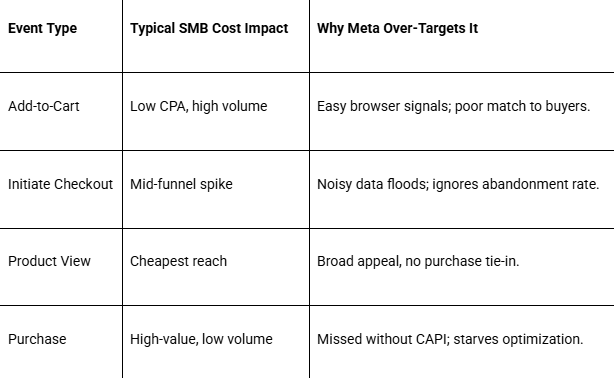
Meta's delivery algorithm excels at volume when you optimize for anything short of purchases—it grabs cheap add-to-carts or checkouts from broad pools, not qualified buyers. Solopreneurs hit this wall first: tight budgets exhaust on uninterested clicks because browser pixels fail post-iOS 14, dropping event match rates. Teams argue metrics instead of auditing, as noisy data amps low-signal events over revenue ones.
Your funnel suffers when Meta can't distinguish window-shoppers. Add-to-cart users cost less to target but convert far below purchasers, spiking CPA without sales. Broad reach compounds this—default Advantage+ expands beyond hints, prioritizing volume in low-quality pockets like forced video views or bot-heavy networks.
How Weak Tracking Skews Audience Delivery
Rely on pixel alone, and Meta misses 20-30% of events due to ad blockers or cookie loss, crippling its learning. The algorithm then over-serves "initiate checkout" folks who abandon, as those signals flood in while purchase data lags. For SMBs, this means ads hit broad demographics—older non-buyers or wrong genders—who rack up cheap actions but zero LTV.
Event Match Quality (EMQ) scores tank without hashed user data like emails, so Meta can't link server events to profiles. Result: Advantage+ Shopping or broad audiences chase partial truths, wasting 50%+ of spend on non-converters. EU privacy laws worsen drops, as consent gaps hide even more buyer signals.
Real SMB Pain: Budget Drain on False Signals
Picture a US e-comm solopreneur scaling to $5k/month spend—their ads nail 100 add-to-carts daily at $2 CPA, but sales crawl at 5% rate. Meta's systems, fed incomplete pixel data, expand to "similar" broad pools, burning cash on tire-kickers. EU teams face extra GDPR hurdles, where consent logic gaps drop EMQ further, forcing manual tweaks that kill scale.
This isn't creative failure—it's data poverty. Without purchase-value signals, no value-based bidding; broad targeting defaults, inflating costs 2x on non-buyers. Accounts flag "underperforming" as ROAS dips, but the fix hides in Events Manager: low match scores confirm signal starvation.
Fix It: Feed Purchases via Conversions API
Implement Pixel + CAPI hybrid for 70%+ signal lift—server events bypass browsers, passing hashed emails/phones for true buyer matching. Deduplicate with event IDs to avoid doubles; aim for 50+ weekly purchases to exit learning phase stably.
Start narrow: Seed with customer lists for lookalikes, then test messaging like "Ready to buy? 20% off first order" on high-intent subsets. Audit EMQ weekly—target 8+ score by adding user IDs; this shifts spend to purchasers, cutting waste 30-50%. One DTC brand fixed CAPI gaps for 117% revenue jump via better match quality.
Test in duplicate campaigns: One Advantage+ broad, one original with purchase opt—compare ROAS after 7 days. Your budgets reclaim control, proving "bad accounts" were blind spots all along.
Free 30-Minute Consultation
If your Meta CAPI, GA4, Google Ads, server-side GTM, or offline conversion tracking feels unclear, broken, or incomplete — I can help you identify exactly what to fix and how.
No sales pressure. · No commitment required. · Just actionable advice.
Need Help With Your Tracking Setup?
Contact
Reach out anytime for tracking help.
© 2026. All rights reserved.
Connect with me on LinkedIn